
Introduction:
Service providers and their large customers require connectivity services to have assured quality. These services have a complex "lifecycle". To begin with, there is an ever-increasing demand for shorter times to reach maximum performance operation. And throughout the contract and its renewals, they require quick responses to problems, immediate problem isolation, and almost immediate restoration. We are not only talking about customers with very large corporate networks and broad geographic footprint....this scenario also includes customers such as groups of Premium subscribers (e.g., country clubs), very important sports institutions, etc.Virtualization:
This practice refers to the techniques and methodologies that are gradually transforming the way enterprise services are implemented and managed. Attention: it is not just about evolving towards innovative technology that offers more capacity and new functions!...Virtualization has a revolutionary impact on the way enterprises and their customers interact with networks. For example, consider a situation where a service provider has the opportunity to offer an application that demands improved quality of service (QoS) with ultra-low latency and high security. Suppose it is for a small group of users with different capacity requirements. It can be a challenging implementation to manage such requirements on a physical network where resources may not be shareable, and where creating separate network segments may not be possible without significantly affecting other customers and resources. In summary, the virtualization of network functions offers service providers (and/or their enterprise customers) the flexibility and agility to launch new services and break away from the costly and slow updates of traditional networks.Have you wondered if traffic measurements can be virtualized?
VIAVI has developed virtualized test tools that also interact with the installed base of traditional instrumentation (such as the globally recognized MTS-5800 traffic analyzers). These are centralized test systems through an orchestrator software that we call FUSION®, consisting of virtual testing and analysis tools. It is designed to "live" from day one in an open ecosystem (open architecture using open and standardized software APIs). When measuring, the system addresses traditional "LAN to LAN" measurements (between Ethernet endpoints)…now testers can be either your same MTSs or the so-called "Virtual TestAgents" or VTAs. These VTAs will host valuable measurements at key points, such as edge routers or CPEs). The measurements will NOT be "invasive," though we will aim to inject low-level traffic, enough for the tests to produce good test information, and always following a convenient workflow (such as to minimize service impact). In this regard, we note that given the inherent ubiquity that can be achieved with this measurement technique, we can literally "set up" hundreds of link measurements...take them proactively, repeatedly, accumulate statistics...trigger actions by comparisons to pre-defined KPIs, etc.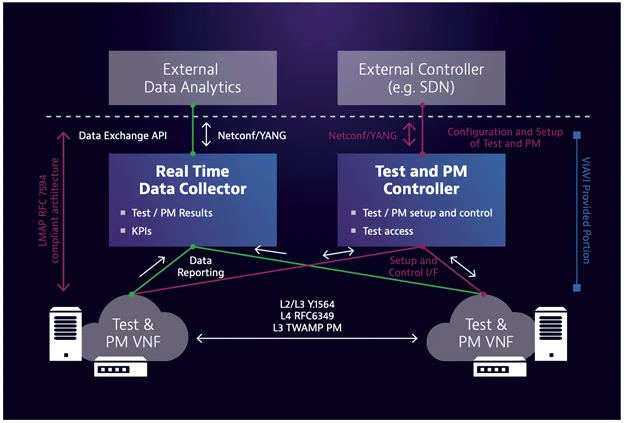
The new RFC7594 "LMAP" standard
We cite below the introductory text of this IETF Request for Comment (IETF=Internet Engineering Task Force): "There is a desire to coordinate the execution of broadband measurements and the collection of measurement results over a large set of measurement agents (MA). These MA could be software agents on PCs, agents embedded in consumer devices (such as TVs or gaming consoles), embedded in service provider controlled devices such as set-top boxes and home gateways, or simply dedicated probes. The MA could also be embedded in a device that is part of an ISP's network, such as a DSLAM (Digital Subscriber Line Access Multiplexer), router, operator-grade NAT (Network Address Translator), or ISP gateway. A measurement system is expected to easily span from a few hundred thousand or even millions of such MA. Such scale presents unique challenges in coordinating, executing, and collecting measurement results". We close the quote here and note in bold that this comment refers exactly to test systems such as those proposed by VIAVI with the FUSION discussed above.Support for traditional measurements
But a manufacturer of measurement instrumentation must, for good practice reasons, adhere to measurement techniques approved by the industry and standardized by institutions such as the aforementioned IETF, ITU-T, or MEF (Metro Ethernet Forum). VIAVI has specifically transferred our world-class experience and KnowHow, implementing in FUSION® the test functions according to RFC2544, Y1564, and RFC6349, in order to expand that power of testing (already available in the mentioned physical instruments) within the virtualized Workflow. However, it is important to clarify that when the demand for test traffic level requires it...there may be situations where in traditional style, we will need to "cut service". It could even happen that the test agent cannot achieve the test level from the assigned HW. In these cases, FUSION® will resort to an MTS!. But the fact is that even so, the "orchestration" of the measurement will remain under the account and control of our "Test Controller".
Benefits of this testing approach
You will benefit if you have "physical" instruments such as MTS5800 or ONX580/620, Smartclass, etc.You will be able to make more optimized use of them (as the scarce resources they are). You could, for example, reassign a “Test Agent” to such or such location or network point, thus preserving the invaluable use of a 1G or 10G (or 100G as applicable) generator for cases that justify it (for example, dedicating it to “always serve by default from a central site).
You will be able to have an immediately deployable testing capacity. That is, the ability to address a first (and immediate) response to the question of what is happening with the KPIs of service “x” (between given Metro Switch and given CPE), at such or such large corporate customer.
If problems manifest as an impact on the QoE (Quality of Experience) level?. Typically if there is poor traffic perception at layer 7 and poor quality of real-time (but services over TCP)?…
Well then, “execute an RFC6349 orchestrated between the two VTAs (virtual Test Agents) that cover most of that EVC (Ethernet Virtual Circuit)”. Doing this will give us an immediate quantification of what/where/how the problem is occurring. The solution may not be immediate certainly…but we can segment…we can even measure at lower layer levels. Let’s see:
If the problem drops to layer 3 or lower…then depending on the traffic we can inject, we use the VTAs again, or we use a VTA and an instrument.
If needed we can also measure between an instrument and an Ethernet OAM device (Y1731)… or against a TWAMP loop (at L3…something typically found on cell site routers in mobile networks)…and several other possible alternatives to quickly act and resolve.
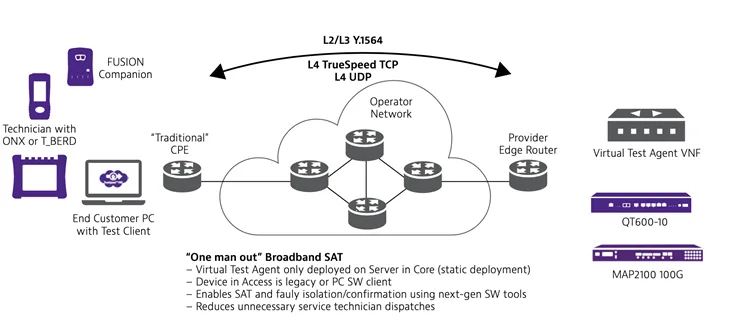
So suppose the problems turn out to be of a physical nature, such as optical link breaks: undoubtedly, people will need to be dispatched to take optical layer measurements…
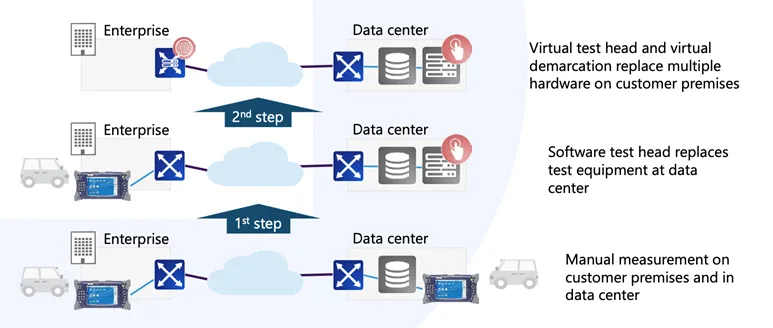
But as you can see in the figure, after the resolution action (possibly by a contractor), what follows is again a dynamic of “preventive test workflows” and other O&M work. That is, the profound change is the fact that we have a context of “virtualized” testing resources.
Before and after this or other contingencies, your FUSION® system has collected and will continue to collect the information needed to ensure the desired quality level in services. You could allocate more or less of those test resources for higher-revenue services, and/or services with higher “complication”…in terms of customer management, accessibility, and O&M complexity, etc. That is, you will be making more intelligent and cost-effective use of OPEX from your test and measurement investment.
CONCLUSIONS
We conclude that "quality assurance" for the lifecycle of network services finds in the technique of virtualized tests AN IMMEDIATE ALLY- Virtual tests not only simplify O&M operations, they make them more accessible, easier, and faster to implement.
<li>The idea of being able to "go measure" in immediate time, <strong>becomes plausible and viable</strong></li>
<li>Planning O&M strategies based on central tools that connect to distributed virtual probes and agents will progressively minimize the operational cost of measuring. <strong>But moreover…more measurement means fewer random instances regarding service states</strong></li>
<li>The not insignificant fact that you will be able to <strong>re-signify the use of valuable instruments</strong> (which often are "too" often stored and unproductive) so that under <strong>FUSION®</strong> control they dedicate themselves to taking statistical measurements automatically (without requiring hours of your technicians' time).</li>
<li>Note that finally the vision proposed in the <strong>RFC7594 standard has taken hold, which allows thinking of a context of standardization and best practices when going to virtualized testing.</strong></li>
<li>In that sense, VIAVI aims for your virtualized testing platform to <strong>be scalable with your network growth and to have open, standardized, and flexible NFV interfaces and infrastructures</strong>. FUSION® integrates "from day one" with your NOC software platforms <em>(see Datasheet for details on which ones)</em></li>
Please contact us and we will be happy to provide more information about our portfolio of virtualized testing solutions.