
Wireless technology has revolutionized the way we live and work, especially with the introduction of smartphones, wireless sensors, and IoT. The ecosystem of applications for entertainment, business, and mission-critical tasks is driving technological change at unprecedented levels.
In general, there is an expectation that 5G will be an innovation platform that provides the ability to bring new services to market quickly. This will enable service providers to take advantage of market opportunities and dynamically meet changing needs of consumers and enterprises.
Some of these use cases include:
- Internet of Things (IoT) mobile that connects billions of sensors and machines.
- Ultra-fast broadband that offers gigabits of bandwidth.
- Mission-critical communication that enables very low latency and near real-time feedback with high reliability and enables new applications such as autonomous driving and remote surgery.
5G Requirements:
Radio technology improvements
The set of radio access technologies needed to meet future requirements must be adaptable but efficient to support a diverse set of services for massive connectivity, massive capacity, ultra-reliability, low latency, etc.
The network must adapt to the use it serves.
Consider the use case involving connected cars. In this case, a 5G network must provide continuous connectivity to ensure reliable service. Most connected devices produce multiple types of data traffic, sending less user data than a typical smartphone. But the type of continuous data coming from connected cars will require a lot of signaling relative to the small volume of user data, which again is dramatically different from the traffic characteristics of standard smartphones. This will require low latency and high availability, connection time sensitivity that requires enhanced security, much higher than a smartphone. The network must also be able to perform over-the-top (OTT) application updates and security patches. Within the same vehicle, passengers may be watching high-definition videos simultaneously; in this case, the same network is required to meet several distinct sets of performance characteristics. The same area of the network may also need to support industrial IoT or other services that have a separate set of service requirements.
Unlike previous technological inflection points, such as 2G to 3G or 3G to LTE, the 5G radio service will be a combination of LTE improvements plus an overlay of new radio access technologies (NR).
Key drivers of 5G Radio Access Technologies (RAT)
Enhanced Mobile Broadband (eMBB): eMBB provides higher speeds for applications such as streaming, web access, video conferencing, and virtual reality. To do this it uses carrier aggregation, superior modulation schemes, tighter integration of LTE with unlicensed bands, massive MIMO, Coordinated Multipoint (CoMP), Heterogeneous Network (HetNet) support and Dual ConnectivityMillimeter waves:
Certain eMBB use cases demand fiber-like connectivity, which means delivering several gigabits per second performance. This level of network capacity would only be achieved if more spectrum were available.Millimeter-wave spectrum is the band above 28 GHz and is significantly large compared to the different licensed and unlicensed services offered below 6 GHz spectrum. A millimeter wave offers greater bandwidth and performance due to the large size of available transmission bandwidth. High frequency means narrow wavelengths, which means that mmWave is more vulnerable to gases, rain, and humidity, and as a result suffer large propagation loss and are more susceptible to blockage.
Although poor propagation is characteristic of mmWave and a major concern, it significantly reduces the size of the antenna array, since wavelength (λ) is directly proportional to the size of the antenna element, allowing for larger antenna arrays with smaller antenna elements.
Larger antenna arrays can mitigate propagation losses, especially by using advanced beamforming techniques. Experimental systems using antenna arrays have demonstrated reliable communications at 28 GHz, even under dense, urban, non-line-of-sight conditions, for distances up to 200 meters. Terminal-side antenna arrays have space limitations, but some basic beamforming is possible.
On the base station side, arrays can include hundreds of antennas in an approach called “massive MIMO.” Massive MIMO could also improve SINR through narrow beamforming, bringing the system closer to a noise-limited environment. Therefore, by combining the benefit of the potential availability of ten times the amount of spectrum, and using a combination of high and low frequencies, they can be instruments for 5G operation. Lower bands can be used for robust coverage and control, while higher bands can provide opportunistic access for high data rates.
Evolved Machine-to-Machine Communication (eMTC):
Current cellular technology is not very well optimized for eMTC. Low-power wide-area (LPWA) solutions and services have existed for many years, but are fragmented and non-standardized, leading to certain deficiencies, such as poor reliability, poor security, and complex implementation, as well as high operational and maintenance costs.Narrowband IoT (NB-IoT):To overcome these challenges, 3GPP began work on standardizing requirements for the new narrowband cellular-based technology aimed at IoT. Some of the key requirements for IoT can be summarized as follows:
- Long battery life: more than 10 years, since many IoT devices will run on batteries and often the cost of replacing batteries in the field is not viable.
- Low device cost: less than 5 USD per module, for a positive business case when billions of devices need to be integrated, this is essential.
- Low implementation cost: plug-and-play to reduce OpEx.
- Extended coverage: maximum coupling loss (MCL) of 164 dB, 20 dB better than General Packet Radio Service (GPRS), generally NB-IoT devices tend to be placed in areas with weak signal, such as basements and remote rural areas.
- Support for a large number of devices: 40 devices per home or 50K per cell.
NB-IoT requires a minimum system bandwidth of 180 kHz for DL and UL, respectively. The choice of minimum system bandwidth enables several implementation options for NB-IoT as shown in the figure below.
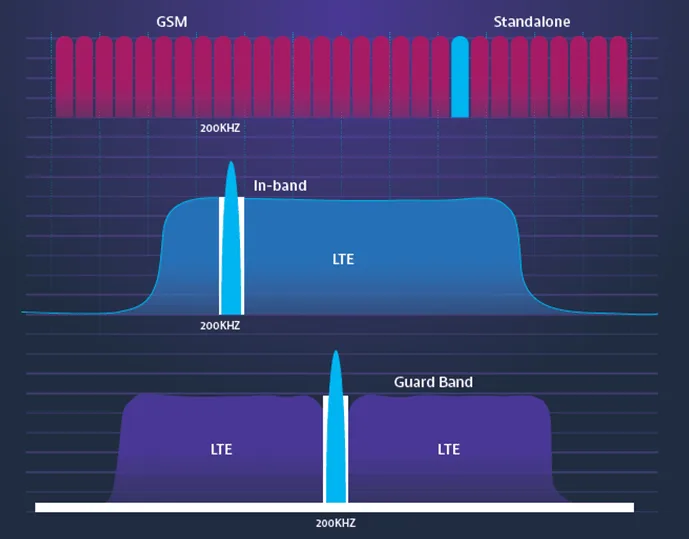
Implementation options for NB-IoT
- Standalone: GSM remains the dominant mobile technology in many markets and the vast majority of cellular M2M applications use GPRS/EDGE for connectivity. By repurposing GSM carriers to carry NB-IoT traffic, GSM operators can ensure a smooth transition to LTE for MTC in the future. This approach will also accelerate the time to market for IoT and maximize the benefits of globally scaled infrastructure
- In-Band: The LTE in-band option provides the most spectrum and cost-efficient implementation of NB-IoT for service providers with LTE service. The NB-IoT carrier is a standalone network element that uses a single physical resource block (PRB). If there is no IoT traffic, a physical resource block (PRB) from an available NB-IoT carrier can be used for other purposes, since the use of LTE and NB-IoT infrastructure and spectrum are fully integrated. The base station scheduler multiplexes NB-IoT and LTE traffic on the same spectrum, which minimizes the total cost of operation for MTC, which increases with the volume of MTC traffic.
- Guard band: Applies to both WCDMA and LTE
Latency
One of the main objectives of 5G is to provide ultra-reliable and low-latency communications (URLLC). URLLC is at the heart of mission-critical applications such as drone control, remote surgery, and self-driving cars. This type of application is potentially what will deliver the greatest social benefits, driven by high reliability and extremely short network latency time. According to 3GPP TR 38.913 (V0.3.0, March 2016), the targets are identified as 0.5 msec for DL and 0.5 msec for UL for URLLC and 4 msec for UL and 4 msec for DL for eMBB. Some of the proposed work items to achieve those targets can be summarized as:Non-orthogonal multiple transmission: Orthogonality in OFDM prevents interference and creates great capacity, but requires extensive signaling and increases latency. Non-orthogonal multiple access (NOMA) and sparse code multiple access (SCMA) could complement orthogonal access by leveraging advanced interference cancellation techniques, thus reducing latency.
New multicarrier radio transmission: LTE uses OFDM, but other possible multicarrier schemes include Filter-Bank Multi-Carrier (FBMC) transmission, universal filtered multi-carrier (UFMC) transmission, and generalized frequency division multiplexing (GFDM) as part of the new 5G radio interface. Potentially, it can decrease latency in UL transmission due to lower synchronization requirements.
Mobile-Edge Computing: ETSI is standardizing Mobile-Edge Computing, a technology that enables a programmable application environment at the edge of the network, within the RAN. Objectives include reduced latency, more efficient network operation for certain applications, and improved user experience. Although MEC emphasizes 5G, it can also be applied to 4G LTE networks.
Backhaul and Fronthaul
As discussed earlier, 5G network technologies will demand extreme bandwidth and, for certain use cases, ultra-low latency. To achieve those objectives, fronthaul and backhaul are required. Fiber fronthaul with CPRI or OBSAI technology, which is the link between RRH and the BBU, has been widely implemented in distributed RAN.CPRI/OBSAI allows operators to evolve their networks to a centralized RAN (C-RAN) architecture that enables much more efficient use of resources and differentiated services.
In C-RAN, service providers are co-locating a group of BBUs in a remote location; while remote radios are connected to the BBUs via a fiber link. Co-location of BBUs enables service providers to maximize the use of the cellular coordination schemes offered in LTE-Advanced. For example, the Coordinated Multipoint (CoMP) function requires close coordination between several geographically separated eNode-Bs (eNBs). eNBs are dynamically coordinated to provide joint transmissions and scheduling, as well as joint processing of received signals. In this way, two or more eNBs can serve the User Equipment (UE) at the edge of a cell to improve signal reception/transmission and increase throughput, particularly under cell edge conditions. However, to achieve that, eNBs should be able to provide a very low level of latency. The additional processing required for multi-site reception and transmission could significantly increase delays. Having BBUs co-located in a C-RAN architecture helps in those scenarios.
Fronthaul links based on CPRI are already known for their strict delay and jitter requirements. However, in the cloud RAN environment, the need to closely coordinate transmission for dense radio deployments will create unprecedented requirements for performance, latency, timing, and synchronization.
Currently, CPRI is limited to a capacity of 24 Gbps, which is sufficient to carry approximately 2 Gbps of traffic from the cell site. For example, a 20MHz LTE channel that can deliver up to 150 Mbps in the DL direction will require a CPRI data rate of 2.5 Gbps. This may not be sufficient for 5G networks, where cell sites may be delivering data at tens of Gbps per sector. Fronthaul bandwidth is not the only challenge for 5G deployments. These challenges have created multiple initiatives from the industry to help mobile network operators. Projects like the Next Generation Fronthaul Interface (NGFI) and the 5G-Xhaul forum are working to provide platforms for vendors and service providers to deploy 5G networks with different network capabilities and latency demands.
The NGFI proposal is based on two things:
- Functional split between BBU and RRU functionality, where some of the baseband processing functions are moved to the RRU, of course this will change the BBU and RRU architecture.
- Fronthaul changes from a point-to-point connection to a multi-to-multi Fronthaul network, using packet-switching protocols.
In summary, wireless backhaul is a promising alternative to fiber links, and rather than competing with fiber, it will complement fiber solutions and can be considered an extension of fiber.
Why testing becomes more important in 5G?
As network user growth stabilizes, service providers look to improve their ROI. However, some of these will offer major challenges in terms of network quality, reliability, and availability. For example, mission-critical applications will demand a network that cannot fail, which means ensuring that network quality will be at the center of network deployment and management. Whether it is the fiber interface, which will do all the heavy lifting in the network, or the air interface that will manage all critical applications, or the agile network core, all of them must be continuously monitored and optimized.Network quality depends on the rigor of testing and measurement during the entire network lifecycle. It is essential to ensure that all network components and their interfaces are delivered according to design to reduce CAPEX and OPEX.