
Synchronization is one of the most critical functions of a communication system, especially for Time Division Duplex (TDD), where both uplink and downlink are on the same frequency and the possibility of interference is much more significant. As a result, we see stricter requirements for timing and synchronization for both TDD LTE and 5G-NR.
TDD turns out to be a more attractive option from a spectrum efficiency perspective because it requires only unpaired spectrum to operate, which is beneficial considering the scarcity of frequency resources.
Understanding the TDD Slot Format
Like LTE, 5G radio frames have a fixed duration of 10 ms. Each radio frame contains ten 1 ms subframes. The difference with LTE is that in 5G-NR, the slot and symbol duration depends on the numerology. See Figure 1.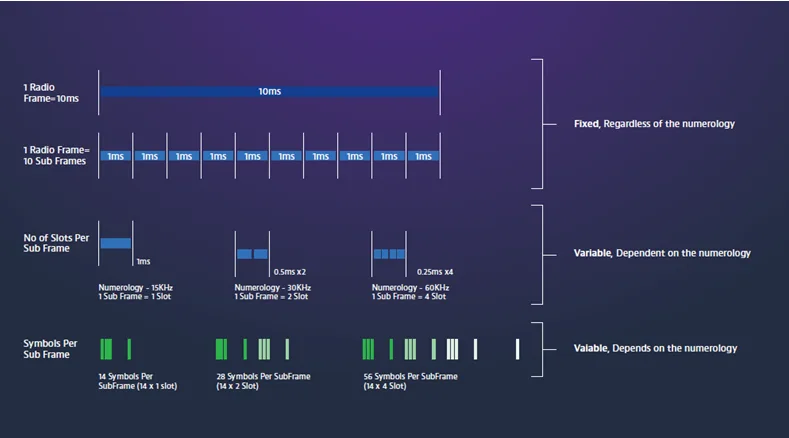
As the subcarrier spacing changes, so does the number of slots and symbols per subframe. For example, 15 KHz has a 1 ms subframe duration that equals one slot containing 14 symbols. For a subcarrier spacing of 30 KHz, one subframe equals 2 slots of 0.5 ms duration each and 28 symbols, and so on (for normal cyclic prefix).
These formats allow flexibility in terms of the service supported on a node. This also creates a challenge if two networks offering different types of services are located side by side, as interference can occur.
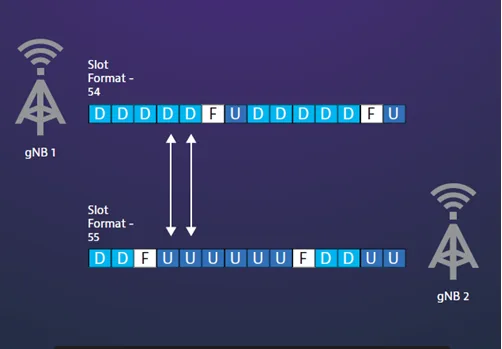
The Importance of Synchronization
If the radio clock loses synchronization precision, or the radios are not synchronized, in a TDD channel, the TDD frame will drift outside the guard period and interfere with adjacent cellular sites. The less precise the clock source, the greater the likelihood of timing shifts that ultimately bring performance and interference problems. The following are the types of interference problems that can occur in a TDD environment:
- Intra-cell Interference
Interference caused within the same cell due to large timing inaccuracies. The probability of interference within a cell is low because in a TDD cell, the scheduler organizes different users in different slots.
- Inter-cell Interference
When users in adjacent cells are scheduled on the same subcarriers but with different DL/UL slots, there is a possibility of inter-cell interference, particularly if the cells are not synchronized to a common clock. Figure 3 reveals the four possible scenarios.
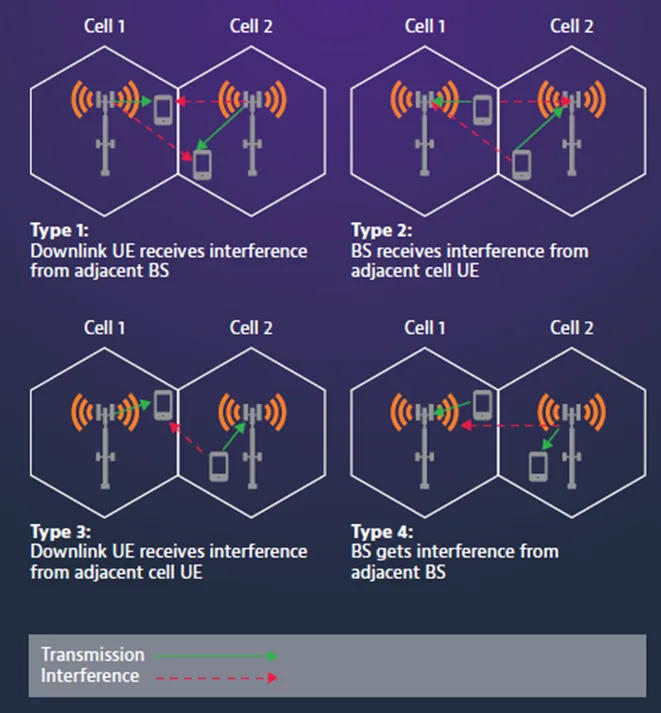
In general, to avoid such interference use cases, all base stations in a network must synchronize to a common clock phase reference (for example, UTC - Coordinated Universal Time). According to ITU-T standard recommendations, 5G-NR TDD and LTE-TDD networks must be synchronized in phase to limit end-to-end timing error to less than 1.5 μs. These 1.5 μs consist of an absolute time error of 1.1 μs to the access point and 0.4 μs in the fronthaul to the radio.
- Cross-Link/Slot Interference
Another potential TDD network interference case is cross-link interference between networks. This occurs when two TDD networks are deployed in blocks within the same band causing interference when simultaneous uplink and downlink transmissions are made on different TDD networks as shown in Figure 4.
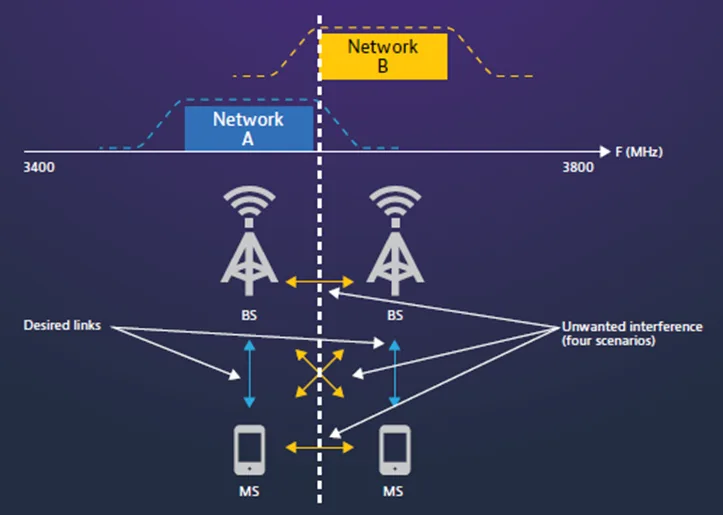
In this case, the base station (BS) or UE belonging to one network transmits while another BS or UE belonging to the other network receives; this scenario is called simultaneous UL/DL transmission.
In summary, for a TDD LTE or 5G-NR network (where TDD is the only option for C-band), we not only need frequency and phase synchronization, but also frame and slot synchronization to avoid inter-network interference.
Types of Synchronization
Synchronization can be identified as the following types:
- Frequency Synchronization
Two clocks that are aligned in terms of their repetition interval (i.e., frequency) but not in terms of phase or time.

- Phase Synchronization
Two clocks that are aligned in terms of their repetition interval (i.e., frequency) and also phase (a one-second interval), but without a common time origin.
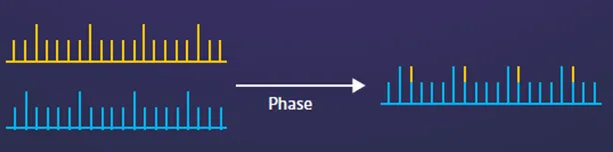
- Time Synchronization
Two clocks that are aligned in terms of their repetition interval (i.e., frequency), their phase (a one-second interval), and share a common time origin.
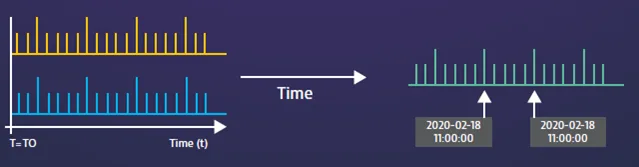
- Frame Synchronization
Basically, simultaneous UL and DL transmissions do not occur, that is, at any given time, all networks transmit in DL or all networks transmit in UL adopting a single frame structure for all involved TDD networks and synchronizing the frame start across all networks.
Standard Requirements for Timing and Synchronization
Synchronizing different nodes within a network means distributing time and frequency in a network of clocks, distributed over a wide geographic area with a common primary source (PRTC). All communication networks require that nodes be synchronized to properly demodulate received signals.
In wireless communications, the receiver has no prior knowledge of the physical wireless channel or the propagation delay associated with the transmitted signal. Typical communication receivers use low-cost oscillators to keep device costs manageable. These oscillators inherently have some drift. Therefore, by using time synchronization as a process by which a receiving node determines the correct time instance at which to sample the incoming signal and carrier synchronization as a process by which a receiver adapts the frequency and phase of its local carrier oscillator to those of the received signal, the receiving node can properly demodulate received signals.
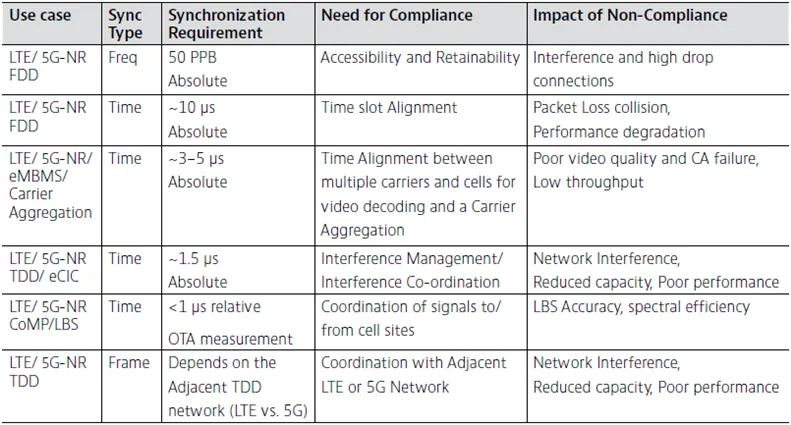
The definition and synchronization procedures can vary depending on the specific communication system. In Table 2 you can observe the timing and synchronization requirements, the type of synchronization and whether absolute or relative synchronization is needed and the effects of compliance.
Synchronization Options
As shown in Figure 9, in 3G and 4G cellular networks, satellite receivers are integrated into NodeB and BBU.
These controllers take the time of day messages and propagate them over the air to the UE. They also take the precisely timed pulse received every second (1PPS) and use it to keep all cellular tower frequencies synchronized.
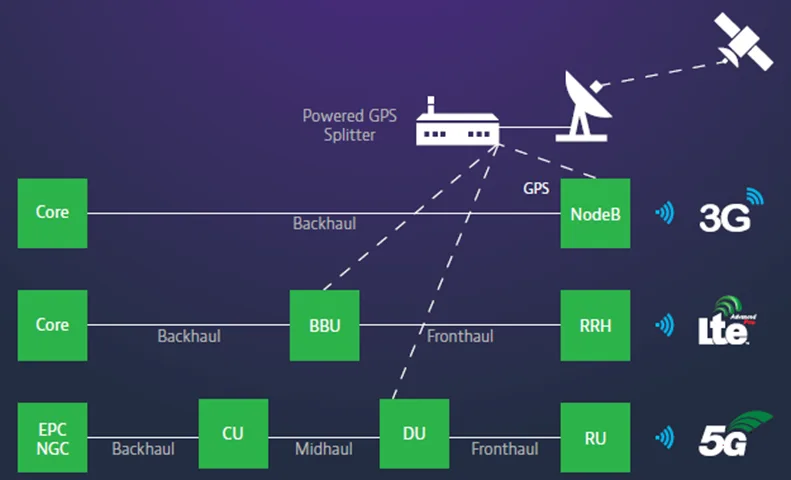
Time of day messages will still be received and sent over the air to the UE and Distributed Units (DU), which is the name of the controllers used in 5G networks. DU will also continue to use the 1 pulse per second (PPS) received from the satellite to keep frequency synchronized. However, for overlapping cell phase synchronization, we need network equipment to have access to the same time source and time-of-day messages from that source.
For this type of synchronization, line of sight to multiple satellites is required. The same challenge is also present in a 4G network using LTE-TDD technology that also requires phase synchronization.
To fully understand the exact time of day at the satellite receiver, we must be able to compensate for the delay between when the satellite sends the time-of-day message and when that message reaches the satellite receiver. However, this becomes a challenge because satellites are not stationary above us.
The challenge is handled as follows. All satellites periodically transmit a mathematical description of their orbit, and all satellite receivers calculate a precise position of where they are located.
This calculation uses the mathematical technique of trilateration, which is similar in concept to triangulation. Once a precise position is calculated, in other words, once the survey is complete, the delay between the satellites and the satellite receiver can be calculated to “correct” the time of day it was received.