
Data transport technologies (links and network elements) are undergoing a full technological transition toward packet-switching architecture, essentially asynchronous. Yet it is necessary to improve latencies and asymmetries in order to implement synchrophasors and other time-sensitive technologies
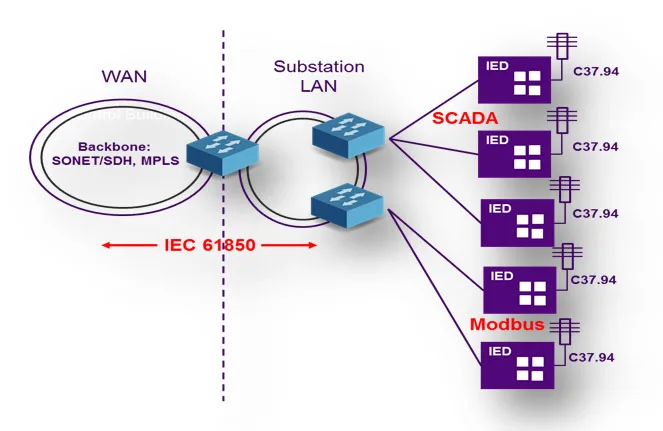
- It is necessary to measure not only the WAN backbone but data distributions in substation LANs in order to verify availability, performance, delays, etc., of all associated services
- Intrasubstation data transport relies on QOS/Ethernet/C37.94, with very demanding key performance indicators (KPI) defined by IEEE and IEC.
- In the case of inter-substations, PDH/SDH "transport" is being replaced by MPLS-TP (IEC61850)
- Coexistence is required with low-speed serial services (e.g., SCADA)
- Non-critical services (videoconferences, perimeter security, etc.) are being added to data transport
Recommendations for Traffic Verification:
- Quality objectives and PASS/FAIL verdicts defined according to RFC-2544, RFC-1564, RFC-6349, MEF10.2
- Examples of KPIs:
- Throughput
- One-way latency
- Packet jitter
- Frame loss rate
- Committed burst size
- Service availability
- Control traffic transparency
Recommendations for Synchronization Verification
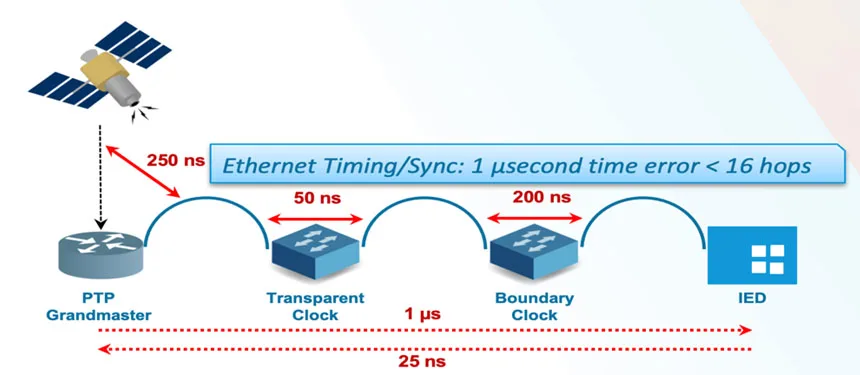
Within the framework of full use of IEEE1588 “PTP” protocol (IEC/powerprofile), Max|TE| < 1µs must be met between endpoints, and asymmetry in the round-trip path < 25nseg
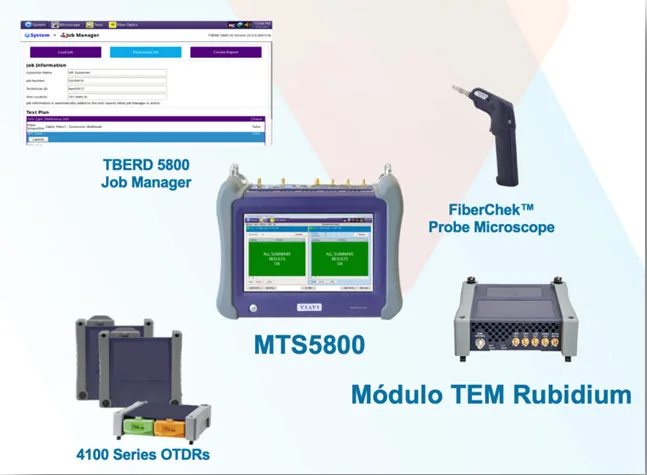
- This requires the use of an instrument with primary self-reference (internal GPS and HOLDOVER via Rubidium)
- Measure from primary clock (GrandMaster) to synchrophasor at the end of the synchronization chain
- Measure TC (Transparent clocks) and BC (Boundary clocks) equipment, whose respective PARTIAL TIMEs are 50 and 200ns respectively
- Considering measurements within shelters implies battery-operated tester, capable of maintaining primary precision (frequency + phase) for several hours
Current Connectivity Facilities
Within the framework of measurements requiring logistics and geographic deployment, it is highly valuable and beneficial for the instrument to have the advantages of current connectivity technologies:
- Have operational managers embedded in instruments that interact via BT with the operator's mobile phone, fully access cloud data management systems, enable rapid transfer of pass/fail reports, configuration details, etc., between test site and office.
- Have geographic usage tracking and a solid "anti-theft" blocking system